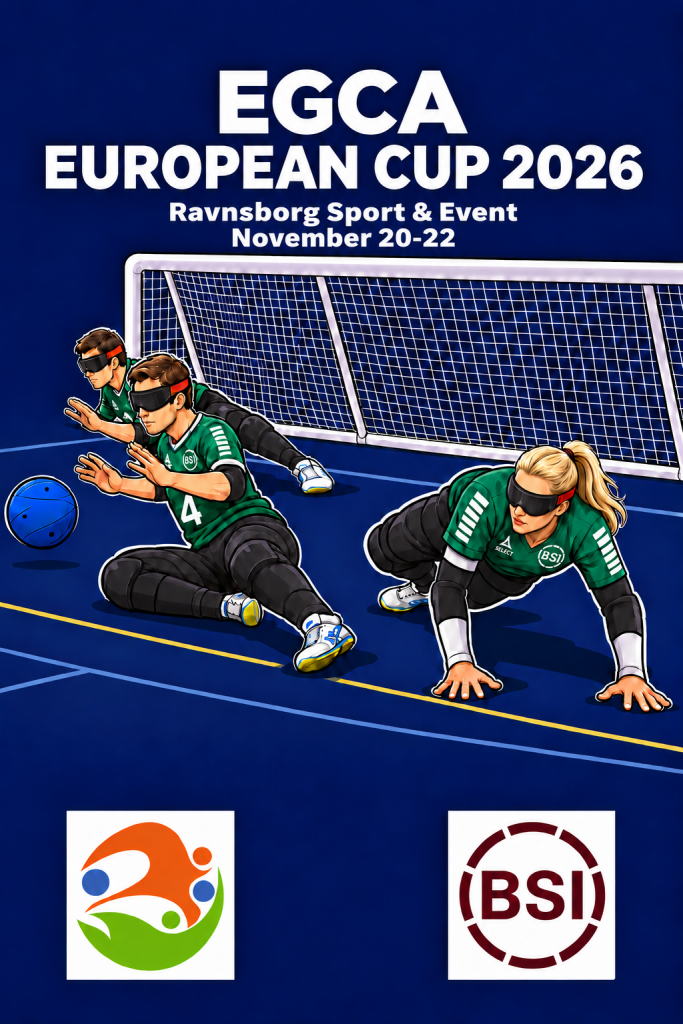
The second-ever EGCA European Cup tournament will take place in Køge, Denmark, from 20–22 November. Seven teams from seven different countries will compete in the tournament. The event is intended for clubs that participated in the Qualification Stage of the 2026 EGCA Champions League but failed to qualify for the Final Stage.
In this article, you will find information about what is at stake in the tournament, how to follow the action, the competition format, the video review and team challenge system being tested by EGCA, and an overview of each team’s prospects heading into the tournament.
WHAT IS AT STAKE?
The tournament winner is guaranteed a place in next season’s EGCA Champions League Qualification Stage. In addition, teams will earn valuable EGCA Champions League ranking points, which could prove crucial in securing qualification for next season’s Champions League Qualification Stage.
You can find the current EGCA Champions League ranking and the EGCA European Cup points system here.
HOW TO FOLLOW THE TOURNAMENT
You can find the tournament’s official website here.
All tournament matches will be available via livestream on the EGCA GoalballTV YouTube channel. Every match will feature English-language commentary.
EGCA’s social media channels (Facebook and Instagram) will provide results and updates from the tournament throughout the weekend.
TOURNAMENT FORMAT
The following teams will participate in the tournament: BSI Copenhagen (host club, Denmark), FC Porto (Portugal), GC NAIS (Serbia), GC Niksic (Montenegro), Kleio Thessaloniki (Greece), ONCE Catalunya (Spain) and SSG Blista Marburg (Germany)
The tournament will feature a single round-robin phase. Following the preliminary round, the top two teams will advance to the gold medal match, while the teams finishing third and fourth will compete in the bronze medal match.
The tournament will be played according to the current IBSA rules.
Teams will earn 3 points for a win, 1 point for a draw and 0 points for a loss in the preliminary round. The standings will be determined according to the following criteria:
A. Points earned
B. Goal difference
C. Goals conceded
D. If two teams remain tied after criteria A–C, the team that won their head-to-head match will be ranked higher.
E. If two teams remain tied after criteria A–D, an extra throws competition will be organised between the teams to determine their final ranking.
The medal matches must produce a winner. If a match is tied at the end of regulation time, a six-minute golden-goal overtime period will be played, with the first team to score declared the winner. If the match remains tied after overtime, an extra throws competition will determine the winner.
VIDEO REVIEW & TEAM CHALLENGE
The 2026 EGCA European Cup will serve as a test event for EGCA’s video review and team challenge system, which may be introduced in the 2027 Champions League season.
TEAM-BY-TEAM PREVIEW
BSI Copenhagen
Tournament hosts BSI Copenhagen competed in the Odivelas Qualification Stage of this year’s Champions League. The Danish side made an excellent start to the tournament in Portugal, defeating eventual Final Stage qualifiers FSBU Gothenburg of Sweden 5–3.
Unfortunately, the team then suffered a series of defeats and eventually finished bottom of the standings.
The team’s most experienced player is undoubtedly 35-year-old Gustav Koch Rasmussen, who carries significant responsibility in the attacking game. We are also looking forward to seeing what young Danish players Silas Friis-Hansen and Jens Dahl can produce on home soil.
Swedish player Ludvig Nilsson will also have an important role to play as the team’s center player, and his performances could prove crucial to Copenhagen’s chances of success.
FC Porto
The reigning Portuguese champions are among the strongest favourites for this year’s EGCA European Cup.
FC Porto produced some excellent performances in the preliminary round of the Odivelas Champions League Qualification Stage. However, their dream of reaching the Final Stage for the second consecutive season came to an end in the quarter-finals, where they lost 5–7 to FSBU Gothenburg. Porto eventually finished sixth in the tournament.
Fabio Oliveira is one of the biggest stars in both the Porto squad and the entire tournament. Diogo Azevedo also showed excellent attacking form in Odivelas, meaning that Porto have plenty of firepower among their wingers.
It will be interesting to see which of the team’s two center players, João Macedo or Felipe Baptista, receives more playing time this time around.
It would hardly come as a surprise if FC Porto were to feature in Sunday’s final.
GC NAIS
The Serbian club hosted the Champions League Qualification Stage in the city of Niš. GC NAIS organised an excellent tournament, although their own performances on the court did not quite go according to plan.
The team now travels to Denmark highly motivated, particularly as its squad includes several Serbian national team players preparing for the upcoming Division C European Championships, which are now just four months away.
GC NAIS have also strengthened their squad with a major attacking addition. Athanasios Chatzipantou, a familiar face from the Greek national team and Kleio Thessaloniki, will make his first appearance in a GC NAIS shirt.
Chatzipantou is a significant reinforcement for the team. However, GC NAIS will still need to improve their defensive game considerably if they are to challenge for a place in the medal matches.
GC Niksic
GC Niksic have been among Europe’s strongest clubs in recent years, making their fourth-place finish at the Niš Qualification Stage and subsequent failure to qualify for the Berlin Final Stage a major disappointment.
The team committed a huge number of attacking mistakes in Niš, so they certainly know where improvements are needed if they want to win the European Cup. They undoubtedly have the quality to do so.
The Nikolic brothers are the backbone of the team, and GC Niksic will also welcome the return of the reliable Milos Ranitovic, who was absent from the Niš tournament.
With Ranitovic back in the squad, Niksic should be a very strong contender for the title this weekend, provided they can avoid becoming too eager and making unnecessary attacking mistakes.
Kleio Thessaloniki
Kleio Thessaloniki also competed in the Niš Qualification Stage but were unable to secure a place in the medal matches.
Following the departure of long-time star player Athanasios Chatzipantou, the team have been left with a significant gap in their attacking game. In Niš, young Alesio Delia took on some of the scoring responsibility, but this was not enough, particularly as the team’s defence also struggled at times.
The first priority for Kleio this weekend will be to get their defensive game back on track if they want to compete for victories in Køge. This task will be made even more challenging by the absence of Alesio Delia from the squad.
Much of the team’s attacking responsibility will fall on Ivailo Vatov and Georgios Papadopoulos. Greek women’s national team star Vasiliki Agko will also undoubtedly play an important role, particularly in defence.
ONCE Catalunya
The Spanish Goalball League champions ONCE Catalunya were in excellent form when they hosted the Champions League Qualification Stage in Barcelona. However, they eventually had to settle for fourth place and missed out on qualification for the Berlin Final Stage.
ONCE Catalunya would certainly have been among the favourites for this year’s European Cup if two key Spanish national team players, Felix Vargas and Genis Quiroga, had not withdrawn from the squad at the very last moment.
The absence of these two players is a significant blow to the team’s chances. This means that the tournament will be an important opportunity for ONCE Catalunya to develop as a team and for new players to step up and take on greater responsibility.
We will be particularly interested to see whether players such as Serhi Baron can reach a completely new level, with considerable responsibility resting on his shoulders in the attacking game. It will also be exciting to see whether any new names emerge on the international stage.
SSG Blista Marburg
SSG Blista Marburg head to Denmark in a positive frame of mind after winning bronze in the German Bundesliga just last weekend. The team will certainly be buoyed by their remarkable recovery, having climbed back from the brink to secure a Bundesliga bronze medal.
In the Champions League, Marburg competed in the Odivelas Qualification Stage, where they produced some very encouraging performances.
Among other results, they defeated the Fen Tigers, who eventually qualified for the Berlin Final Stage and finished fifth in Europe, by an impressive 9–1 scoreline in the preliminary round. However, the team also produced some rather disappointing performances in other matches.
Marburg will need to find greater consistency if they want to feature in this weekend’s medal matches.
Nils Emig scored goals at an impressive rate during the Odivelas Qualification Stage, and we will also be watching with great interest the performances of Mogdim Ehzan, born in 2006, as he takes to the international stage.
SSG Blista Marburg are undoubtedly the dark horses of this tournament.