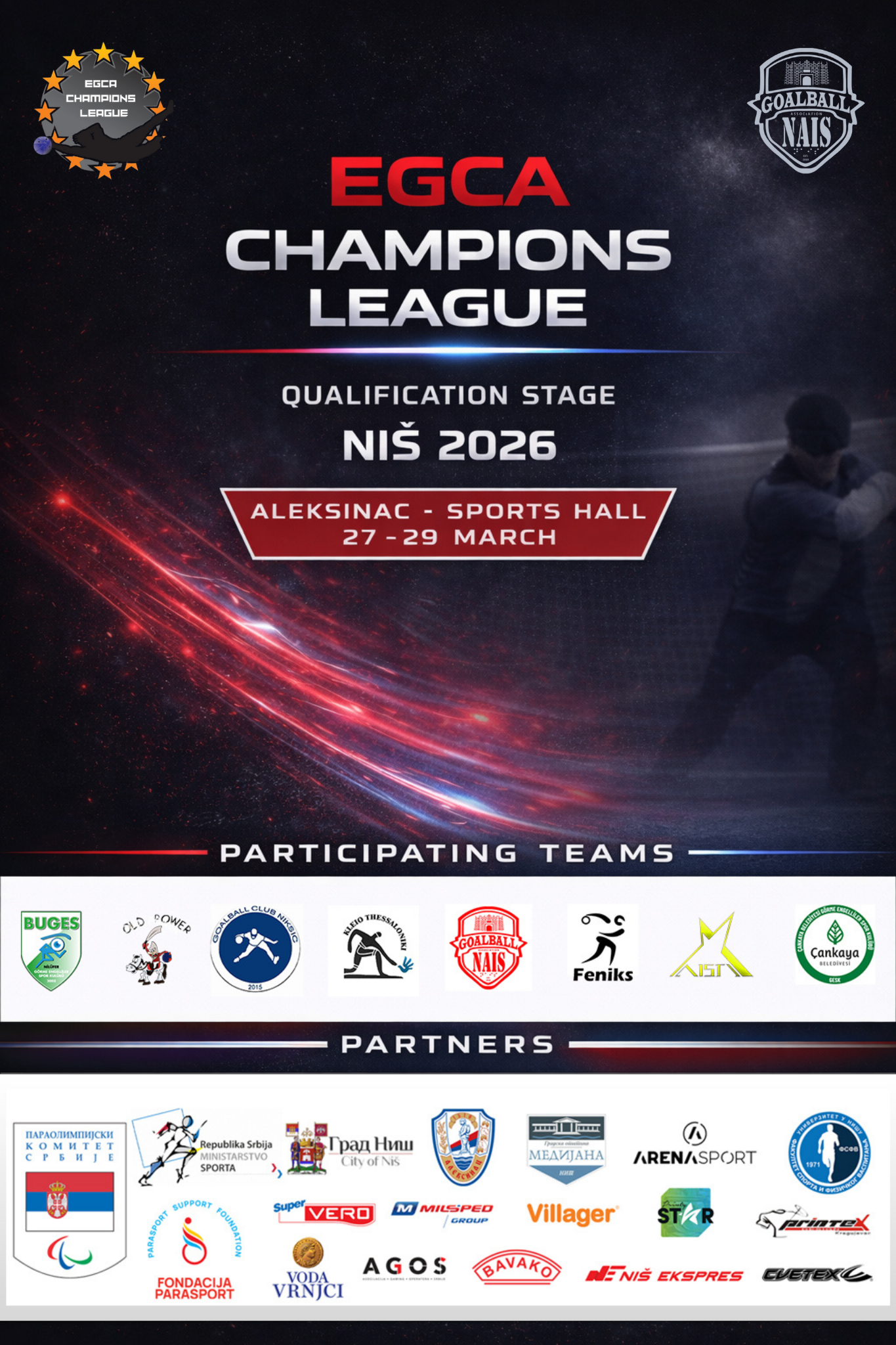
The biggest EGCA Champions League season in history will continue with the 3rd and the last qualification stage of the season that will take Place in Niš, Serbia from 27th to 29th March 2026. The tournament is head-organized by GC NAIS in cooperation with European Goalball Club Association. 8 clubs from 6 different countries will fight for the Top 3 positions in the tournament for qualifying to the Final Stage of the season that will take Place in Berlin, Germany from 16th to 20th September. Below you can find the starting points of the tournament for each team.
HOW TO FOLLOW THE TOURNAMENT
The tournament will be livestreamed on GoalballTV YouTube channel with English commentary (main commentators Christoph Scholtz and Dzenan Ajdinovic).
EGCA social media channels will update information and results from the tournament as well as the organizer’s Instagram page that you can find by @GC_NAIS_
HOW THE TOURNAMENT IS PLAYED
The eight teams are divided into two preliminary groups of four teams each. During Friday, the teams play a single round-robin within their group, after which they are ranked for the quarterfinals. A team earns 3 points for a win, 1 point for a draw, and 0 points for a loss in a preliminary group game.
The ranking of teams in a preliminary group is determined by the following system:
A. Earned points
B. Goal difference
C. Goals conceded
D. If two teams remain tied after criteria A–C, priority is given to the team that won the head-to-head match between them
E. If two teams remain tied after criteria A–D, an extra throw competition is organized between those teams to determine their ranking
In Saturday’s quarterfinals, the winner of one group faces the fourth-placed team of the other group, and the runner-up faces the third-placed team of the opposite group. The winners of the quarterfinals advance to the semifinals and medal matches, while the losers play for places 5–8.
The winners of the semifinals advance to the final and at the same time secure their place at the Final Stage in Berlin. The winner of the bronze medal match will also earn a place at the Final Stage. Placings beyond the top three are also important, as they determine the teams’ ranking in the Champions League, which provides a pathway to qualify for the EGCA European Cup later in the autumn.
In the quarterfinals, semifinals, medal matches, and placement matches, each game is played to a decisive result. If the match is tied after regulation time, a 6-minute golden goal overtime is played (the first team to score wins). If the game remains tied after overtime, an extra throws competition is used to determine the winner.
GROUP A
NILÜFER BUGES
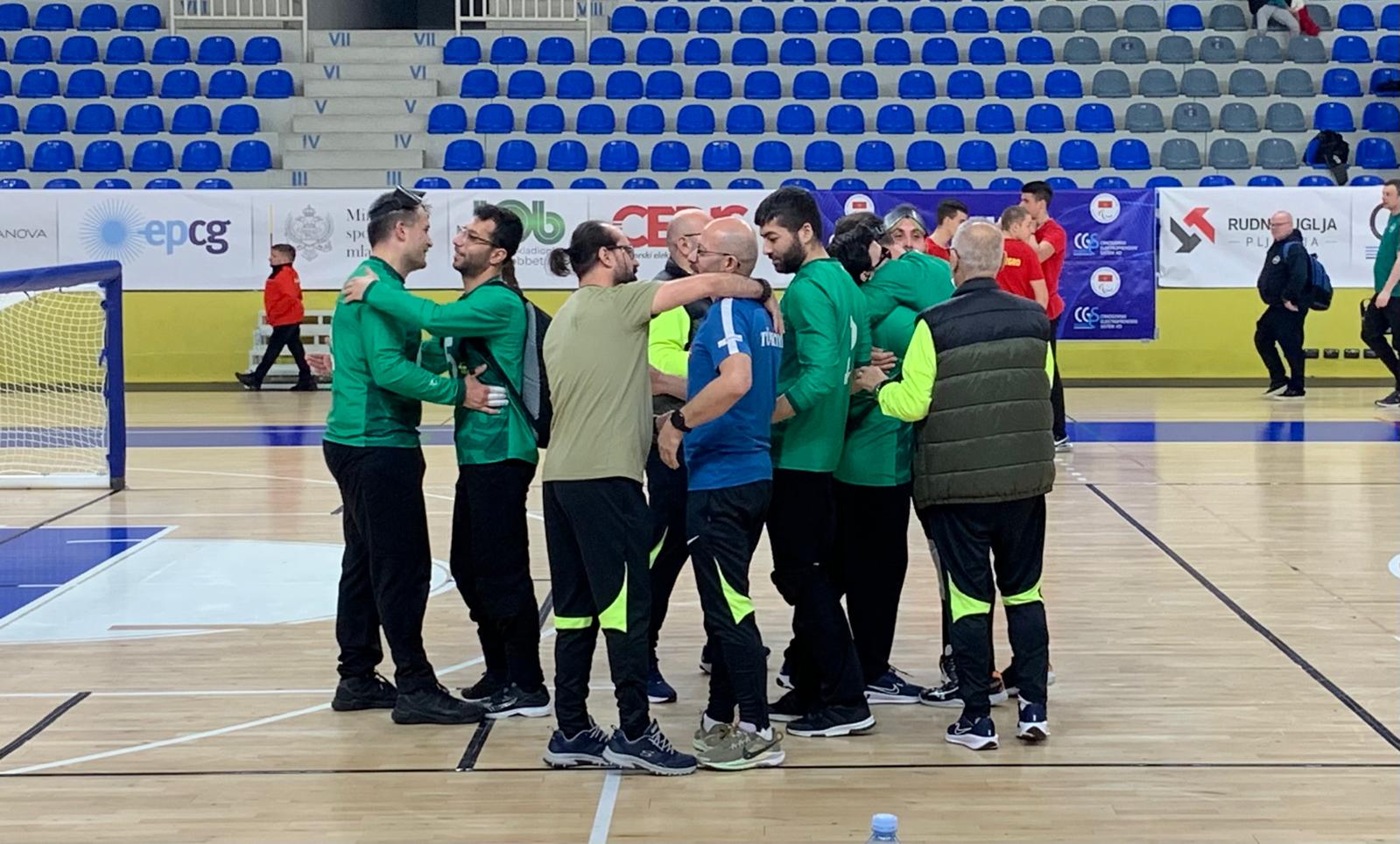
The reigning Turkish champions Nilüfer Buges made history last season by becoming the first Turkish club to compete in the EGCA Champions League. In their debut campaign, they reached the Final Stage in Matosinhos and ultimately secured an impressive sixth-place finish. The team is undoubtedly aiming for another Final Stage appearance this season, led by their star player Ebubekir Siddik Kara. In his first Champions League season, Kara scored 45 goals, finishing fifth in the overall scoring rankings. However, the team’s defensive performances were at times inconsistent last season—something they can hardly afford this time around. The top teams in the Niš tournament are so experienced and high-quality that even the smallest mistakes will be punished. Nilüfer Buges also cannot rely solely on Kara’s scoring output; additional contributions will be needed from Turkish national team player Bilal Tekin as well as Hilmi Uslu, who secured the domestic league title for the team last autumn.
KLEIO THESSALONIKI
The Greek side Kleio Thessaloniki faces a new reality, as their roster no longer includes Athanasios Chatzipantou—a notable absence that significantly changes the team’s dynamics. This puts the squad coached by Meni Kessanopoulou in a completely new situation. Without their primary offensive weapon, the team must approach Champions League matches from a different perspective. The most experienced players in the squad are Bulgarian Ivailo Vatov and Greek women’s national team star Vasiliki Agko, while the rest of the roster consists of relatively young or inexperienced players at Champions League level. Expectations are modest, but it will be interesting to see how the team performs in a clear underdog role. Kleio possesses strong defensive capabilities that could trouble stronger opponents, but realistically, they are likely to compete for places 6–8 in the tournament.
GC NAIS
Host team GC NAIS will be looking to improve on last season’s Champions League campaign, where they finished at the last spot without a win in the qualification tournament in Podgorica. This time, the team is aiming to secure its first victories in the competition. While still not among the main favorites, GC NAIS has strengthened its squad with two Bulgarian reinforcements, Veselin Kushnerenkov and Aleksej Dinkov, making the team more competitive. The preliminary roster also included Israeli rising star Doron Hodeda, but unfortunately, due to the current global situation, he will not participate. The team’s main challenge lies in defense, as they conceded too many goals last season to seriously challenge stronger opponents. If GC NAIS has managed to tighten its defensive play, it could pose a real threat in individual matches—particularly in the quarterfinals—but reaching the Final Stage would still be considered a huge sensation.
AISTI SPORT
Aisti Sport from Vantaa, Finland returns to the Champions League after missing last season. The rapidly developing multi-parasport club has endured a difficult domestic campaign, which makes this tournament an important opportunity to bounce back. The team’s core trio—Markus Tihumäki, Miika Honkanen, and Leo Hintsanen—have all represented Finland at international level, including the European Championships in Pajulahti last autumn. While they possess significant potential, recent performances at both national and international level have fallen short of expectations. Tihumäki is clearly the key offensive player, while Honkanen’s experience will be invaluable against strong opponents. Aisti Sport has a solid chance of collecting valuable ranking points toward a European Cup qualification, but reaching the Final Stage would be a major surprise.
GROUP B
CLUB FENIX
The North Macedonian champions Club Fenix face a tough challenge in their first-ever Champions League appearance, having been drawn into a preliminary group with three strong contenders for the Final Stage. The team’s primary goal is to gain experience and develop for the future, aiming to challenge Europe’s elite in the coming years. Club Fenix is not entirely new to EGCA competitions, having participated in the Grand Prix tournament in Niš a few years ago. Additionally, several players—such as Milosh Grlica, Filip Arsov, and Miroslav Topalov—have gained international experience playing for GC NAIS in previous tournaments.
GC NIKSIC
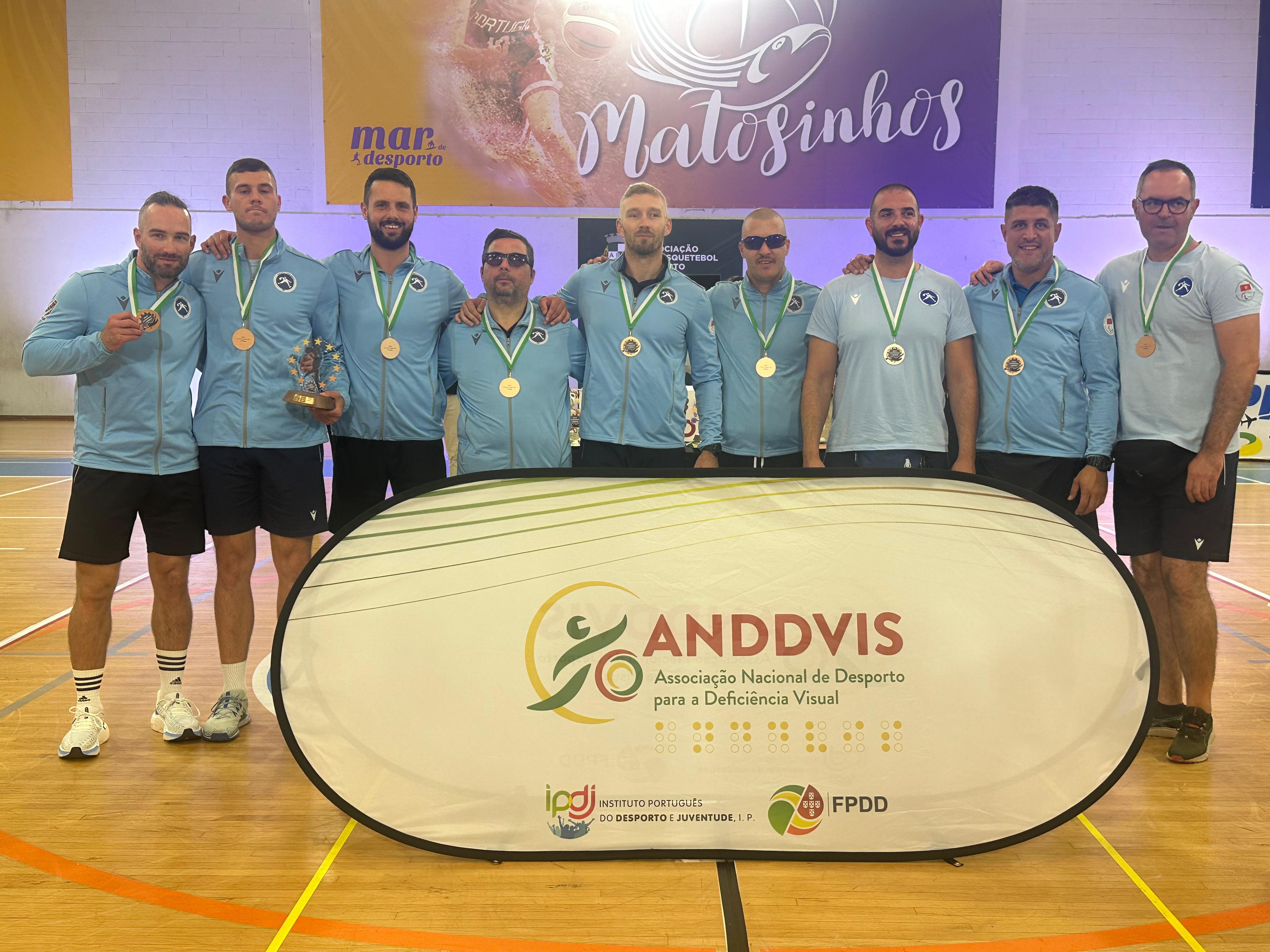
Montenegrin powerhouse GC Niksic has reached the Final Stage in all four of its Champions League appearances and has claimed three medals—one silver and two bronze. Last season, they once again secured bronze by defeating Polish side BRUK-BET Termalica Krakow, with Nikola Nikolic scoring the golden goal in overtime. Nikolic has been in phenomenal form over the past four seasons, scoring a remarkable 290 goals and ranking seventh on the all-time scoring list. His brother Marko Nikolic has also surpassed 100 career goals and remains a key figure for the team. With Milos Ranitovic absent, Slovenian legend Matej Ledinek is expected to take on increased responsibility. GC Niksic is a strong contender for the semifinals and medal matches—but whether they can go all the way remains to be seen.
OLD POWER
Old Power has consistently reached the Final Stage in every Champions League season but has narrowly missed out on medals in recent years. Now, the Finnish club from Espoo has assembled an exceptionally strong roster. In addition to their Finnish core, the team is reinforced by Lithuanian stars Nerijus Montvydas and Mantas Brazauskis. Montvydas has previous experience with the club, while Brazauskis makes his debut, bringing valuable stability to the center position. Offensive firepower is certainly not an issue: the squad includes two of the all-time top scorers of the Champions League —Erkki Miinala and Montvydas—as well as Ehsan Zoveidavi, who has scored over 200 Champions League goals. The coaching staff is equally impressive, featuring the head coaches of both the Finnish and Lithuanian national teams. With immense experience and expertise, Old Power has all the tools needed for success. The key question is whether the team can build sufficient chemistry during a short tournament weekend to reach the final.
CANKAYA
Cankaya, based in Ankara, Turkiye, finished third in the Turkish league last season, just a few points behind champions Nilüfer Buges. Now, they make their debut in Europe’s premier club competition. The squad boasts extensive international experience, with nearly all players having represented the Turkish national team. Ekrem Gündogdu stands out as a key player, having been a central figure for Turkiye in several major tournaments. He is expected to pose a significant threat in Niš as well. Cankaya also has strong attacking options across the roster, but their success will likely depend on how effectively they can organize their defense when it matters most. Alongside Nilüfer Buges, GC Niksic, and Old Power, Cankaya is undoubtedly among the top contenders in the tournament.